
po3mah reviewed Fahrenheit 451 by Ray Bradbury
why i didn't read it before
5 stars
It's like it was written today. Spoiler: Protect books at all costs.
It's like it was written today. Spoiler: Protect books at all costs.
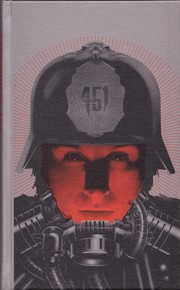
Ray Bradbury’s classic envisages a dystopian future in which the job of firemen is to seek out books and burn them. In this edition, introduced by Michael Moorcock, Sam Weber’s astonishing illustrations perfectly capture the novel’s haunting atmosphere.
In 1950, Ray Bradbury had a kernel of an idea for a story, and rented a typewriter in the basement of the UCLA library for nine days (it cost him $9.80). Dashing from the basement to the stacks to track down half-remembered quotations and typing at furious speed, in that short time he produced the first draft of an extraordinary novel. Serialised, widely published, adapted for film, theatre and even opera, the book, as Bradbury wrote, ‘seems to have a life that goes on recreating itself’.
Ray Bradbury’s classic envisages a dystopian future in which the job of firemen is to seek out books and burn them. In this edition, introduced by Michael Moorcock, Sam Weber’s astonishing illustrations perfectly capture the novel’s haunting atmosphere.
In 1950, Ray Bradbury had a kernel of an idea for a story, and rented a typewriter in the basement of the UCLA library for nine days (it cost him $9.80). Dashing from the basement to the stacks to track down half-remembered quotations and typing at furious speed, in that short time he produced the first draft of an extraordinary novel. Serialised, widely published, adapted for film, theatre and even opera, the book, as Bradbury wrote, ‘seems to have a life that goes on recreating itself’.
Source: www.foliosociety.com/book/FRH/fahrenheit-451
It's like it was written today. Spoiler: Protect books at all costs.
It's like it was written today. Spoiler: Protect books at all costs.
It's like it was written today. Spoiler: Protect books at all costs.
It's like it was written today. Spoiler: Protect books at all costs.
As you're reading this book, it's difficult to remember that it was written in 1951. The technological "predictions" are interesting (bluetooth headphones, reality TV). But I think the most interesting portions are the discussions of the nature of books and media. Toward the end, we get a discussion of people as books (using their innate photographic memories to read/scan books that can later be retrieved from them), but this quotation from Faber around the middle of the book is probably my favorite moment...the texture of books, a texture that can be examined closely, and the rewards of that process of examination.
"Do you know why books such as this are so important? Because they have quality. And what does the word quality mean? To me, it means texture. This book as pores. It has features. This book can go under the microscope. You'd find life under the glass, …
As you're reading this book, it's difficult to remember that it was written in 1951. The technological "predictions" are interesting (bluetooth headphones, reality TV). But I think the most interesting portions are the discussions of the nature of books and media. Toward the end, we get a discussion of people as books (using their innate photographic memories to read/scan books that can later be retrieved from them), but this quotation from Faber around the middle of the book is probably my favorite moment...the texture of books, a texture that can be examined closely, and the rewards of that process of examination.
"Do you know why books such as this are so important? Because they have quality. And what does the word quality mean? To me, it means texture. This book as pores. It has features. This book can go under the microscope. You'd find life under the glass, streaming past in infinite profusion. The more pores, the more truthfully recorded details of life per square inch you can get on a sheet of paper, the more 'literary' you are. That's my definition, anyway. Telling detail. Fresh detail." (79)