po3mah reviewed Fahrenheit 451 by Ray Bradbury
why i didn't read it before
5 stars
It's like it was written today. Spoiler: Protect books at all costs.
It's like it was written today. Spoiler: Protect books at all costs.
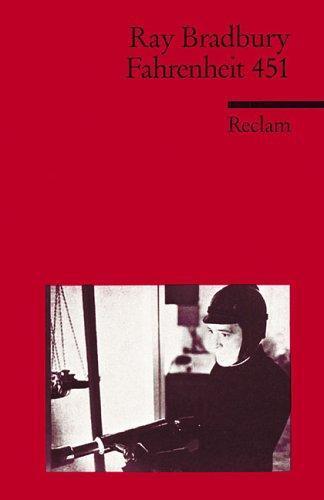
Paperback, 251 pages
German language
Published July 21, 1991 by Reclam, Ditzingen.
Bei 451 Grad Fahrenheit fängt Papier Feuer, auch das Papier in den Büchern, von denen sich Bradburys Zukunftsstaat bedroht fühlt. Feuerwehrmann Guy Montag hat mit seinen Kollegen die Aufgabe, Bücher aufzuspüren und zu verbrennen. Als er Clarissa kennen lernt, die ihn davon überzeugt, dass Literatur fürs Leben nötig ist, ändert er seine Ansichten – und wird zum Rebellen.
Ungekürzte und unbearbeitete Textausgabe in der Originalsprache, mit Übersetzungen schwieriger Wörter am Fuß jeder Seite, Nachwort und Literaturhinweisen.
source: www.reclam.de/detail/978-3-15-009270-5/Bradbury__Ray/Fahrenheit_451
It's like it was written today. Spoiler: Protect books at all costs.
It's like it was written today. Spoiler: Protect books at all costs.
It's like it was written today. Spoiler: Protect books at all costs.
It's like it was written today. Spoiler: Protect books at all costs.
As you're reading this book, it's difficult to remember that it was written in 1951. The technological "predictions" are interesting (bluetooth headphones, reality TV). But I think the most interesting portions are the discussions of the nature of books and media. Toward the end, we get a discussion of people as books (using their innate photographic memories to read/scan books that can later be retrieved from them), but this quotation from Faber around the middle of the book is probably my favorite moment...the texture of books, a texture that can be examined closely, and the rewards of that process of examination.
"Do you know why books such as this are so important? Because they have quality. And what does the word quality mean? To me, it means texture. This book as pores. It has features. This book can go under the microscope. You'd find life under the glass, …
As you're reading this book, it's difficult to remember that it was written in 1951. The technological "predictions" are interesting (bluetooth headphones, reality TV). But I think the most interesting portions are the discussions of the nature of books and media. Toward the end, we get a discussion of people as books (using their innate photographic memories to read/scan books that can later be retrieved from them), but this quotation from Faber around the middle of the book is probably my favorite moment...the texture of books, a texture that can be examined closely, and the rewards of that process of examination.
"Do you know why books such as this are so important? Because they have quality. And what does the word quality mean? To me, it means texture. This book as pores. It has features. This book can go under the microscope. You'd find life under the glass, streaming past in infinite profusion. The more pores, the more truthfully recorded details of life per square inch you can get on a sheet of paper, the more 'literary' you are. That's my definition, anyway. Telling detail. Fresh detail." (79)