po3mah reviewed Fahrenheit 451 by Ray Bradbury
why i didn't read it before
5 stars
It's like it was written today. Spoiler: Protect books at all costs.
It's like it was written today. Spoiler: Protect books at all costs.
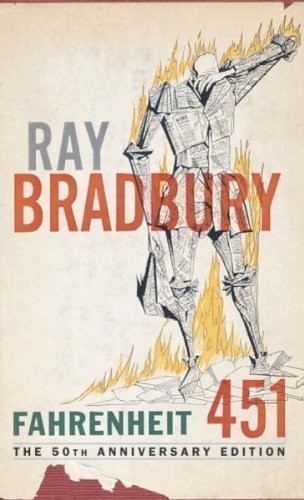
mass market paperback, 184 pages
Published June 26, 1987 by Del Rey.
Fahrenheit 451 is a 1953 dystopian novel by American writer Ray Bradbury. Often regarded as one of his best works, the novel presents a future American society where books are outlawed and "firemen" burn any that are found. The book's tagline explains the title as "'the temperature at which book paper catches fire, and burns": the autoignition temperature of paper. The lead character, Guy Montag, is a fireman who becomes disillusioned with his role of censoring literature and destroying knowledge, eventually quitting his job and committing himself to the preservation of literary and cultural writings.
The novel has been the subject of interpretations focusing on the historical role of book burning in suppressing dissenting ideas for change. In a 1956 radio interview, Bradbury said that he wrote Fahrenheit 451 because of his concerns at the time (during the McCarthy era) about the threat of book burning in the United …
Fahrenheit 451 is a 1953 dystopian novel by American writer Ray Bradbury. Often regarded as one of his best works, the novel presents a future American society where books are outlawed and "firemen" burn any that are found. The book's tagline explains the title as "'the temperature at which book paper catches fire, and burns": the autoignition temperature of paper. The lead character, Guy Montag, is a fireman who becomes disillusioned with his role of censoring literature and destroying knowledge, eventually quitting his job and committing himself to the preservation of literary and cultural writings.
The novel has been the subject of interpretations focusing on the historical role of book burning in suppressing dissenting ideas for change. In a 1956 radio interview, Bradbury said that he wrote Fahrenheit 451 because of his concerns at the time (during the McCarthy era) about the threat of book burning in the United States. In later years, he described the book as a commentary on how mass media reduces interest in reading literature.
In 1954, Fahrenheit 451 won the American Academy of Arts and Letters Award in Literature and the Commonwealth Club of California Gold Medal. It later won the Prometheus "Hall of Fame" Award in 1984 and a "Retro" Hugo Award, one of a limited number of Best Novel Retro Hugos ever given, in 2004. Bradbury was honored with a Spoken Word Grammy nomination for his 1976 audiobook version.
Also contained in:
It's like it was written today. Spoiler: Protect books at all costs.
It's like it was written today. Spoiler: Protect books at all costs.
It's like it was written today. Spoiler: Protect books at all costs.
It's like it was written today. Spoiler: Protect books at all costs.
As you're reading this book, it's difficult to remember that it was written in 1951. The technological "predictions" are interesting (bluetooth headphones, reality TV). But I think the most interesting portions are the discussions of the nature of books and media. Toward the end, we get a discussion of people as books (using their innate photographic memories to read/scan books that can later be retrieved from them), but this quotation from Faber around the middle of the book is probably my favorite moment...the texture of books, a texture that can be examined closely, and the rewards of that process of examination.
"Do you know why books such as this are so important? Because they have quality. And what does the word quality mean? To me, it means texture. This book as pores. It has features. This book can go under the microscope. You'd find life under the glass, …
As you're reading this book, it's difficult to remember that it was written in 1951. The technological "predictions" are interesting (bluetooth headphones, reality TV). But I think the most interesting portions are the discussions of the nature of books and media. Toward the end, we get a discussion of people as books (using their innate photographic memories to read/scan books that can later be retrieved from them), but this quotation from Faber around the middle of the book is probably my favorite moment...the texture of books, a texture that can be examined closely, and the rewards of that process of examination.
"Do you know why books such as this are so important? Because they have quality. And what does the word quality mean? To me, it means texture. This book as pores. It has features. This book can go under the microscope. You'd find life under the glass, streaming past in infinite profusion. The more pores, the more truthfully recorded details of life per square inch you can get on a sheet of paper, the more 'literary' you are. That's my definition, anyway. Telling detail. Fresh detail." (79)