po3mah reviewed Fahrenheit 451 by Ray Bradbury
why i didn't read it before
5 stars
It's like it was written today. Spoiler: Protect books at all costs.
It's like it was written today. Spoiler: Protect books at all costs.
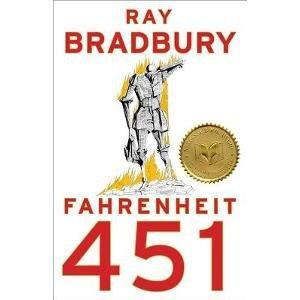
Trade Paperback, 159 pages
English language
Published June 26, 2013 by Simon & Schuster Paperbacks.
Sixty years after its original publication, Ray Bradbury's internationally acclaimed novel Fahrenheit 451 stands as a classic of world literature set in a bleak, dystopian future. Today its message has grown more relevent than ever before.
Guy Montag is a fireman. His job is to destroy the most illegal of commodoties, the printed book, along with the houses in which they are hidden. Montag never questions the destruction and ruin his actions produce, returning each day to his bland life and wife, Mildred, who spends all day with her television “family.” But then he meets an eccentric young neighbor, Clarisse, who introduces him to a past where people didn’t live in fear and to a present where one sees the world through the ideas in books instead of the mindless chatter of television, Montag begins to question everything he has ever known.
This sixtieth-anniversary edition commemorates Ray Bradbury's …
Sixty years after its original publication, Ray Bradbury's internationally acclaimed novel Fahrenheit 451 stands as a classic of world literature set in a bleak, dystopian future. Today its message has grown more relevent than ever before.
Guy Montag is a fireman. His job is to destroy the most illegal of commodoties, the printed book, along with the houses in which they are hidden. Montag never questions the destruction and ruin his actions produce, returning each day to his bland life and wife, Mildred, who spends all day with her television “family.” But then he meets an eccentric young neighbor, Clarisse, who introduces him to a past where people didn’t live in fear and to a present where one sees the world through the ideas in books instead of the mindless chatter of television, Montag begins to question everything he has ever known.
This sixtieth-anniversary edition commemorates Ray Bradbury's masterpiece with a new introduction by Neil Baiman; personal essays on the genesis of the novel by the author; a wealth of critical essays and reviews by Nelson Algren. Harold Bloom, Margaret Atwood, and others: rare manuscript pages and sketches from "Ray Bradbury's personal archive and much more. Here, at last, is the definitive edition of a classic of world literature. (back cover)
It's like it was written today. Spoiler: Protect books at all costs.
It's like it was written today. Spoiler: Protect books at all costs.
It's like it was written today. Spoiler: Protect books at all costs.
It's like it was written today. Spoiler: Protect books at all costs.
As you're reading this book, it's difficult to remember that it was written in 1951. The technological "predictions" are interesting (bluetooth headphones, reality TV). But I think the most interesting portions are the discussions of the nature of books and media. Toward the end, we get a discussion of people as books (using their innate photographic memories to read/scan books that can later be retrieved from them), but this quotation from Faber around the middle of the book is probably my favorite moment...the texture of books, a texture that can be examined closely, and the rewards of that process of examination.
"Do you know why books such as this are so important? Because they have quality. And what does the word quality mean? To me, it means texture. This book as pores. It has features. This book can go under the microscope. You'd find life under the glass, …
As you're reading this book, it's difficult to remember that it was written in 1951. The technological "predictions" are interesting (bluetooth headphones, reality TV). But I think the most interesting portions are the discussions of the nature of books and media. Toward the end, we get a discussion of people as books (using their innate photographic memories to read/scan books that can later be retrieved from them), but this quotation from Faber around the middle of the book is probably my favorite moment...the texture of books, a texture that can be examined closely, and the rewards of that process of examination.
"Do you know why books such as this are so important? Because they have quality. And what does the word quality mean? To me, it means texture. This book as pores. It has features. This book can go under the microscope. You'd find life under the glass, streaming past in infinite profusion. The more pores, the more truthfully recorded details of life per square inch you can get on a sheet of paper, the more 'literary' you are. That's my definition, anyway. Telling detail. Fresh detail." (79)